Short-Range FPV Drone Ferric Dust Neutralization System
Short Brief
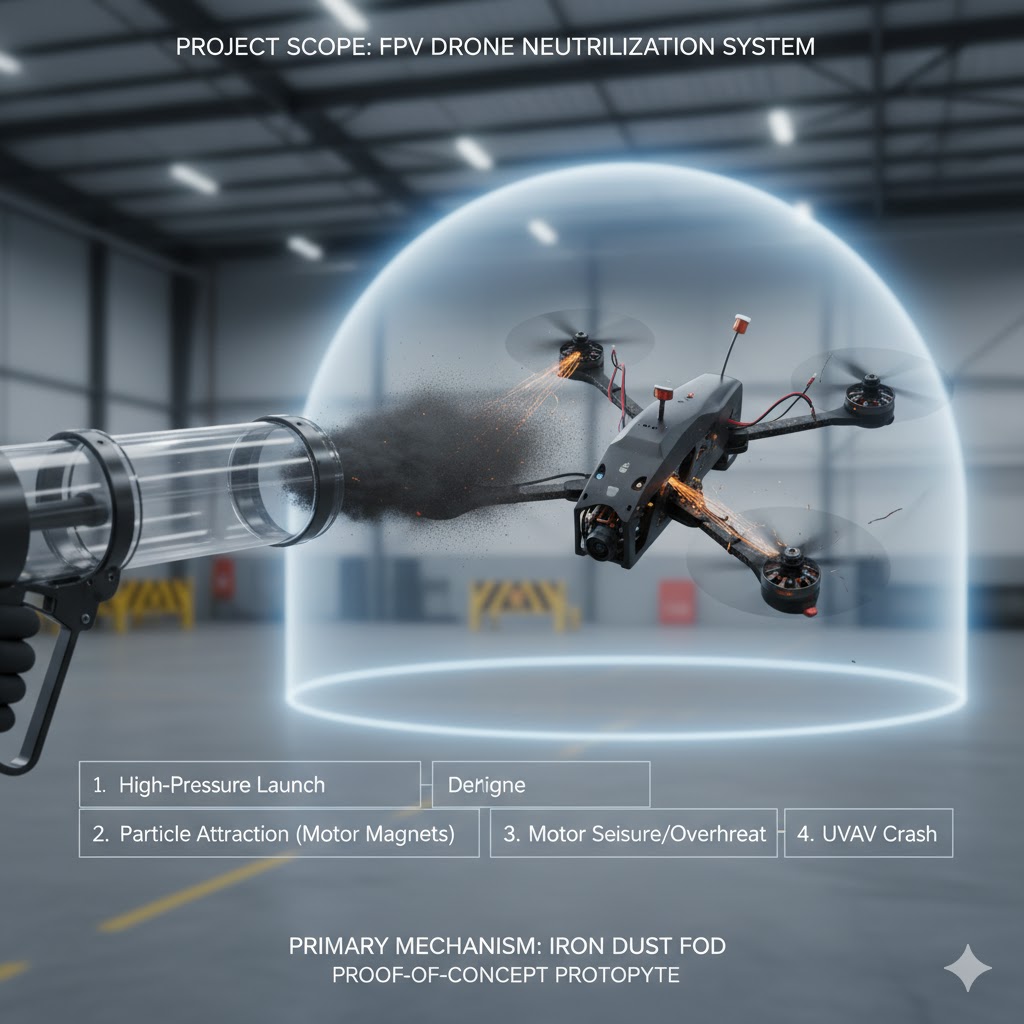
Drone Duster: $3K Full-Spectrum Validation Powder Cake Grenades vs. Dust Barrel Defense The Core Insight FPV kamikaze drones must get within 0.5 meters for lethal payload detonation. You don’t need to destroy the drone—just disrupt its flight path enough that it misses. Iron powder magnetically attracted to motor magnets causes: Motor slowdown from particle accumulation…
Pledged
0.00 USD
Backers
0

Drone Duster: $3K Full-Spectrum Validation
Powder Cake Grenades vs. Dust Barrel Defense
The Core Insight
FPV kamikaze drones must get within 0.5 meters for lethal payload detonation.
You don’t need to destroy the drone—just disrupt its flight path enough that it misses. Iron powder magnetically attracted to motor magnets causes:
- Motor slowdown from particle accumulation
- Physical damage from abrasive scratching
- Motor seizure from magnet-to-magnet binding
- Flight path disruption = mission kill
Two Fundamental Approaches: A/B Testing
Approach A: Powder Cake “Grenade” Launcher
The Concept: Compressed projectile delivering concentrated dust burst
- Pre-formed powder cakes (compressed iron dust pucks)
- Air cannon/CO2 launcher breaks cake apart mid-flight
- Creates dense cloud at target intercept point
- Aiming requirement: 45-degree cone—doesn’t need pinpoint accuracy
- Think shotgun spread vs. rifle precision
Why This Works:
- Drone flying at 60-80 mph enters powder cloud
- Spinning motors (20,000+ RPM) act as vacuum pumps
- Magnetic particles pulled directly into motor housing
- Even partial contamination alters thrust/drag balance
- Flight path deviation of 1-2 feet = drone misses target
Approach B: Dust Barrel Saturation
The Concept: Create persistent defensive cloud in predicted approach corridor
- Large barrel/hopper of loose iron powder
- Leaf blower, compressed air, or explosive dispersal
- Saturates entire area vs. single intercept point
- Coverage: 15-20 foot defensive bubble
Why This Works:
- Drones must fly THROUGH the dust to reach target
- No aiming required—just directional deployment
- Multiple drones affected by single deployment
- Persistent coverage (cloud lingers 10-30 seconds depending on wind)
- Forces drones to alter approach = buys time for other countermeasures
A/B Testing Framework: Which Approach Wins?
Powder Cake System Testing
Launcher Variants:
- CO2 cartridge propulsion (paintball marker style)
- Manual pump pressure chamber
- Spring-loaded mechanical ejection
- Small explosive charge (firecracker-equivalent)
Powder Cake Design:
- Compressed pucks: 2oz, 4oz, 6oz weights
- Binder testing: wax, cornstarch, gelatin (holds shape until impact)
- Fragmentation pattern: How does cake break apart?
- Dust cloud density vs. dispersal distance
Performance Metrics:
- Effective range: 15 / 25 / 35 / 45 feet
- Cloud formation time and size
- 45-degree cone accuracy testing
- Reload speed between shots
- Cost per cake (materials + compression time)
Dust Barrel System Testing
Deployment Variants:
- Leaf Blower Method: Commercial blower + gravity-fed hopper
- Compressed Air Burst: Scuba tank + quick-release valve
- Explosive Dispersal: Small charge underneath powder barrel (claymore analog)
- Multi-Barrel Array: Several smaller barrels creating overlapping coverage
Coverage Pattern Testing:
- Dispersal volume: cubic feet of effective dust cloud
- Persistence duration: seconds until wind clears
- Wind resistance: 0mph / 5mph / 10mph / 15mph conditions
- Saturation density: Can drones penetrate without motor contamination?
Performance Metrics:
- Setup/deployment time
- Area coverage per pound of powder
- Recharge/reload capability
- Cost per deployment
- Tactical positioning requirements
Comprehensive Testing Protocol
Phase 1: Motor Contamination Validation
Benchtop Tests:
- Isolated brushless motors (1806, 2207, 2306 sizes)
- RPM testing: 15,000 / 20,000 / 25,000 RPM
- Iron powder exposure at various concentrations
- High-speed camera: particle attraction to spinning magnets
- Thermal imaging: heat buildup from friction
- Audio recording: motor sound change indicating degradation
Questions Answered:
- How much powder causes noticeable slowdown?
- Does scratching/abrasion occur on motor bells?
- What particle size range is most effective?
- Time-to-failure after contamination?
Phase 2: Powder Cake vs. Dust Barrel
Side-by-Side Comparison:
Test Setup: Small FPV drone hovering at 20 feet
- Powder Cake Test: Launch compressed puck, measure cloud formation, observe motor response
- Dust Barrel Test: Deploy saturation cloud, fly drone through it, observe motor response
- Repeat: 10 trials each method at various distances
Success Criteria:
- Motor RPM reduction (measured via sound frequency analysis)
- Flight instability (wobbling, altitude loss, directional drift)
- Complete motor failure
- Most important: Flight path deviation exceeding 0.5 meters
Phase 3: Moving Target Simulation
Realistic Attack Scenarios:
Powder Cake System:
- Drone flying at 40-60 mph on intercept course
- Defender fires powder cake into predicted flight path
- 45-degree aim cone testing (how forgiving is targeting?)
- Multiple intercept distances: 10 / 20 / 30 / 40 feet
Dust Barrel System:
- Pre-deployed cloud in trench approach corridor
- Drone flies through saturation zone at speed
- Multiple approach angles tested
- Cloud persistence under various wind conditions
Video Documentation:
- Multiple camera angles (side view, overhead, POV from drone)
- Slow-motion capture of powder contact
- Annotated analysis of flight path changes
- Before/after motor performance comparison
Phase 4: Tactical Employment Assessment
Real-World Scenario Testing:
Trench Defense (Dust Barrel):
- Defender creates persistent cloud barrier
- How long does coverage last?
- Can multiple barrels create overlapping fields?
- Effectiveness against drone swarms (3-5 drones)
Personal Defense (Powder Cake):
- Soldier under direct attack from single FPV drone
- Reaction time from detection to deployment
- Hit probability under stress simulation
- Backup shot capability (reload speed)
Vehicle/Position Defense (Hybrid):
- Dust barrel for area saturation
- Powder cake for precision intercepts
- Which combination provides best coverage?
Open-Source Technical Package
Complete Build Guides:
- CAD files for launcher systems (STEP, STL formats)
- Powder cake formulation recipes and compression techniques
- Dust barrel construction plans (multiple scales)
- Bill of Materials with local sourcing alternatives
- Performance data spreadsheets from all tests
GitHub Repository:
- All design files freely downloadable
- Test methodology and raw data
- Video links and supplementary documentation
- Community modification tracking
- Issue reporting for failed replications
Creative Commons License:
- Free for Ukrainian defense use
- Modifications encouraged and welcomed
- Commercial use requires attribution
- Derivative works must remain open-source
Success Metrics: What Victory Looks Like
✅ Demonstrated motor contamination causing measurable performance degradation
✅ Flight path deviation exceeding 0.5 meters documented on video
✅ At least one system achieves 60%+ disruption rate in realistic scenarios
✅ Cost analysis proves economic viability: Sub-$5 per powder cake, sub-$100 per barrel system
✅ Reproducible by local workshops with commonly available materials
✅ Community validation: Other teams replicate results independently
Why 45-Degree Cone Accuracy Changes Everything
Traditional projectile weapons: Require precise tracking and leading moving targets
Powder cake system: Deploy cloud in general intercept zone
- Drone is moving TOWARD defender = easier prediction
- Cloud persists 2-3 seconds = huge margin of error
- Multiple cakes can saturate entire approach corridor
- Defender advantage: Easier to aim, faster to deploy, less training required
Comparison:
- Shotgun aiming vs. sniper rifle precision
- Area denial vs. point defense
- Forgiving vs. unforgiving accuracy requirements
The Tactical Reality: Disruption = Victory
You don’t need to shoot down the drone. You need to make it miss.
Flight path disruption from motor contamination:
- 10% thrust reduction = 1-2 foot deviation at 50-foot approach
- Unbalanced motor performance = unstable flight
- Pilot correction time = additional seconds for other countermeasures
- Forced abort or crash = mission accomplished
FPV kamikaze effectiveness requires:
- Stable flight path for terminal guidance
- Predictable aerodynamics for pilot compensation
- Clean motor performance for thrust vectoring
Iron dust attack vector:
- Introduces unpredictable variables mid-flight
- Pilot can’t compensate for asymmetric motor degradation
- Even non-catastrophic contamination = mission failure
What $3,000 Validates
🧪 Scientific proof: Does magnetic FOD work against real FPV motors?
🎯 Deployment comparison: Powder cake vs. dust barrel effectiveness
📊 Performance data: Range, accuracy, cost, reliability metrics
🎥 Video evidence: Everything documented with multiple angles
📖 Build guides: Complete instructions for community reproduction
🌐 Public knowledge: Released across all platforms for maximum impact
This isn’t proprietary research. This is open-source innovation for collective defense.
The Economic Case: Asymmetric Cost Advantage
Russian FPV kamikaze platform: $400-$600
Ukrainian soldier’s life: Priceless
Powder cake launcher + 20 cakes: $75-$120
Dust barrel system (leaf blower + hopper): $100-$150
If validated, the cost equation shifts:
- $3 powder cake disrupts $500 drone = 166:1 cost advantage
- $150 dust barrel protects position from multiple attacks = force multiplier
- Reproducible with civilian hardware = zero supply chain vulnerability
Failure Is Also Data
If iron powder proves ineffective:
- ✅ We document exactly why it failed
- ✅ We publish all test data for peer review
- ✅ The defense community avoids wasting resources on dead ends
- ✅ We identify what WOULD work based on failure analysis
Transparent negative results are worth funding. They save everyone time and money.
Back Round 1 Validation
$3,000 tests both deployment approaches and gives the world the results.
No proprietary lockdown. No classified findings. Full public release across all platforms.
Every backer becomes part of the open-source defense innovation movement.
Fund Drone Duster—Powder Cake vs. Dust Barrel Testing:
kaizentechlabs.us/fundraising/short-range-fpv-drone-ferric-dust-neutralization-system
Questions We’ll Answer (On Camera, With Data)
- Does iron powder magnetically contaminate FPV motors enough to disrupt flight?
- Powder cake launcher vs. dust barrel saturation—which works better?
- What’s the effective intercept range for 45-degree cone aiming?
- How much flight path deviation results from motor contamination?
- Can this be built by workshop fabricators with local materials?
- What’s the cost per deployment vs. traditional countermeasures?
- How do environmental factors (wind, humidity) affect performance?
- Is this tactically viable for real combat employment?
$3,000 gets answers. Real answers. Published openly. For everyone defending against FPV threats.
Let’s test the physics, compare the approaches, and share the results with the world.